Cass County
Iranistan
(Cold Springs)
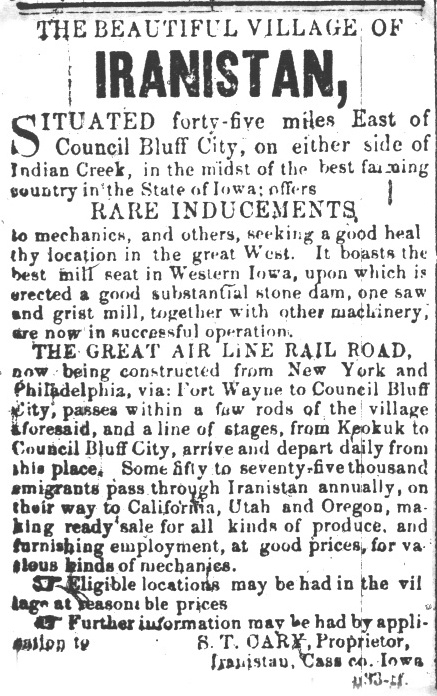
This clipping from the Council Bluffs Bugle of January 2, 1855, stated the following:
THE BEAUTIFUL VILLAGE OF IRANISTAN,
Situated forty-five miles East of Council Bluff City [Kanesville], on either side of Indian Creek, in the middle of the best farming country in the State of Iowa: offers
RARE INDUCEMENTS
to mechanics, and others, seeking a good heal thy location in the great West. It boasts the best mill seat in Western Iowa, upon which is erected a good substantial stone dam, one saw and grist mill, together with other machinery, are now in successful operation.
THE GREAT AIR LINE RAIL ROAD,
now being constructed from New York and Philadelphia, via: Fort Wayne to Council Bluff City, passes within a few rods of the village aforesaid, and a line of stages, from Keokuk to Council Bluff City, arrive and depart daily from this place. Some fifty to seventy-five thousand emigrants pass through Iranistan annually, on their way to California, Utah and Oregon, making ready sale for all kinds of produce, and furnishing employment, at good prices, for various kinds of mechanics.
Eligible locations may be had in the village at reasonable prices.
Further information may be had by application to S.T. CARY, Proprietor, Iranistan, Cass County, Iowa. (1)
"This, the pioneer village of Cass county, was located on the northeast quarter of the southwest quarter of section 8, about two miles west of the present site of the town of Lewis. From the time of its birth until the location of the future county seat it was the principal trading point for all the settlers in the neighborhood. This village and Indiantown were but a mile and a quarter apart, and there was considerable rivalry between them, but Iranistan, having been started first, held its own. F. E. Ball was the original owner of the site, but sold it to Stephen T. Carey, for $500. Carey laid out the town in the winter of 1852-3, and the plat was filed for record on the 1st of March, 1854. Carey was a resident of Council Bluffs, but when at Iranistan he boarded at the house of Nelson T. Spoor.
"In 1854 Nelson T. Spoor bought an interest in the town site and the mill, but Mr. Carey dying the same year, the property passed into the hands of W. N. Dickerson, a man by the name of Jones and others.
"The construction of the saw mill was commenced in 1852, by F. E. Ball, but he shortly after sold it, with the town site, to S. T. Carey, who completed it in the spring of 1853. This was the first mill of any kind in the county, and was of great service in furnishing the settlers with what lumber they required.
"The first building erected in the town after the saw mill was commenced, was W. C. Croft's house, a temporary structure. He kept boarders, among whom were the Buckwalters." (2)
“The town of Iranistan also acquired a post office in 1854. Though doomed, the town showed considerable resilience. Its post office didn't close until April of 1857.” (3)
“In the central part of section 8, Cass Township, about two miles west of the present town of Lewis.” (4)
Cold Springs. The name of the post office at the town of Iranistan from 1851 to 1855. (5)
Indiantown is thought of as the first village in the county, but such is not the case. Iranistan is the pioneer town as it was laid out in 1852 by Stephen Carey on a tract he had purchased for $300.00 from F. E. Ball. Indiantown was not laid out until the summer of 1853 by W. N. Dickerson who had purchased the site from V. M. Conrad. However, Indiantown was known far and wide, while its most important rival, Iranistan, had but local celebrity. . . . Iranistan was the center of social life prior to the founding of Lewis and gambling, horse racing and other sports furnished entertainment for the many who gathered there every Saturday to do their trading. Mr. Ball started a saw mill there in 1852 and after purchasing the townsite, Carey completed the mill, the first in the county. It performed an important service in furnishing settlers with lumber for their new homes. The next structure erected in Iranistan in 1853 was the W. C. Croft boarding house. It was soon followed by the George Shannon blacksmithy, the Peter Hedges hotel and the Leander McCarty dwelling and store. Other merchants in the new town were Jeremiah Bradshaw and Jobe Haworth. Eber and William Buckwalter operated a hotel and livery service and for two years a saloon was operated by O. O. Turner. Dr. John Welch was the first physician at Iranistan. A man named Taylor was the first school teacher, but his service to the community ended tragically when he was drowned while bathing in the Nishnabotna river in June 1853.
In 1920 the state society of the Daughters of the American Revolution erected a marker on the site of the once flourishing village of Iranistan. (7)
Notes:
- Council Bluffs Bugle, January 2, 1855, vol. 4, no. 27, p. 4, col. 1.
- History of Cass County, Iowa, Springfield, Illinois: Continental Historical Company, 1884, 526.
- Floyd E. Pearce, “Indiantown: The Mormon Settlement in Cass County,” Mormon Trail Center, Omaha, Nebraska, featured in The Nauvoo Journal 6, no. 1 (Spring 1994): 22.
- David C. Mott, Abandoned Towns, Villages, and Post Offices of Iowa, reprinted from the Annals of Iowa, 20-21.
- Mott, Abandoned Towns, Villages, and Post Offices of Iowa, 20-21.
- Southwestern Iowa Guide: Geology—Points of Interest—History, WPA, 1936, 40.
- Southwestern Iowa Guide, WPA, 1936, 41.
List of community residents forthcoming
Indiantown, Cass County, Iowa
Location
The first settlers in the area that became Indiantown were the Indians. Prior to the advent of permanent settlers, Mormons on their way from Nauvoo, Illinois to Utah, established a settlement in 1846 on the west bank of the East Nishnabotna River in the vicinity of the deserted Indiantown (1).
Indiantown was central to numerous trails in southwest Iowa. Three routes that took the 49ers across Iowa toward California converged there: the Dragoon Trail, a middle route called Clark's Road and the Mormon Trail to the south. Clark's Road was a more direct route between Des Moines and Kanesville than the Dragoon Trail. From the Des Moines River, the Road proceeded west on the south side of the Raccoon River (2).

Another map drawn in about 1856 shows the location of the settlement.

History
When the Indian title to the lands in western Iowa became extinct by Government treaties in 1846, there was not a white person in all the land. By a treaty made September 26th, 1833, this land was part of a five-million-acre hunting ground, granted to the Chippewa, Ottawa, and Pottawattamie Indians, on condition that they would remove from lands lying farther east that they then occupied. The Indians removed to this area in accordance with that treaty and remained here until by another treaty they agreed to go still farther westward. The treaty last referred to was made at Traders' Point, June 5th, 1846. The Indian inhabitants of this county were of the Pottawattamie tribe. They were quite numerous, and during the years they were here had encampments on the streams in various parts of the county. Their principal village was at a point west of the present town of Lewis, now known as Indiantown, but which the Indians called Mi-au-mise (the young Miami) after their favorite chief. The agency and trading post for these Indians was at Traders' Point on the Missouri river. At that place there was an Indian agent, an interpreter, and a store, at which powder, lead, tobacco, etc., etc., could be bought. At Mi-au-mise (Indiantown) they had a burying ground, where rest the bones of many of their tribe whom death claimed while the tribe hunted elk and deer along the streams and over the prairies (3).
The next inhabitants of the county, after the Indians, were the Mormons, who came through on their westward march from Nauvoo in the fall of 1846. Several thousands of them reached the Missouri River where Council Bluffs now is, in July or August of that year, after a short parley at that point they scattered up and down both sides of the Missouri River. A small number, probably twenty families, got as far eastward as the Nishnabotany River and Indian Creek and on those streams, in the neighborhood of the present town of Lewis, and not far from the deserted Indian village called Indiantown, those twenty families constructed cabins, made "dug-outs" and fixed for the winter of 1846-7 (4).
The Mormon settlement was at Indiantown. The first year that they were here, they were almost destitute of all provisions. No supplies could be had for one hundred miles in any direction. The winter of 1846-1847 was unusually severe and many of the tenderly nurtured women and children succumbed to the hardships.
A Mr. A. G. (probably John C.) Pettengill resided at Indiantown during all the years that the Mormons were there. When he asked to recall the early days, he replied, "'we ground corn, (some we brought with us,) in mills whose burrs were made of common boulders, picked up in Union County. Deer and elk were plenty and afforded us all the meat necessary." Mr. P. also said they got some corn at St. Joseph, Missouri, where there was a ferry in operation across the Missouri. In 1847, they raised enough sod corn to feed themselves and their stock. In that year also they secured the establishment of a post office at their settlement. The post office was called Cold Spring although the settlement was known as Indiantown. Mr. Pettengill was the first postmaster. The mail was carried to Cold Spring once-a-week from the main Mormon camp at Kanesville. The mail carrier also went on to Union County and supplied the Mormon settlement at Mt. Pisgah with mail facilities (5).
In 1849, the Mormon settlers at Indiantown or Cold Spring had the privilege of voting for the first time after settling there. The Mormon vote was worth having then, the population of the State being small, and the leaders of the church were treated with great consideration by men seeking political preferment. James (probably Samuel) Ferrin was the Bishop who took the tithings from the brethren at Cold Spring. Messrs Warner and Bunnell were the preachers. The Mormons did not devote themselves entirely to agriculture and religion. There were two violin players in the settlement, and the folks gathered in each other's houses every night or two and held social dances. The joists in the cabins being low, the tall men would take positions when they danced, that would allow their heads to extend up between the basswood poles that crossed over head (6).
Several of the Mormon families left for Utah, in 1849-50, and when Jeremiah Bradshaw, and family, arrived at Cold Spring Post Office, May 15th, 1851, they found but seven Mormon families there, namely, the two Pettingills, and Messrs. Marsh, Bunnell, Warner, Ferrin and Wicks and their families. There were also two charming Mormon widows who were supported and cared for by the families named. Mr. Bradshaw found the Mormons to be upright people, and good neighbors. The last of the Mormons did not leave until 1852. The only Gentiles living in the County when Mr. Bradshaw came were Wm. S. Townsend and John D. Campbell. Besides having his own family with him, Mr. Bradshaw was accompanied by his son, V. M. Bradshaw and wife; Jesse Hyatt and wife; Lewis Hyatt and wife; and James Sprague and family. After the Mormons had gone westward, Jeremiah Bradshaw, succeeded Mr. Pettengill as postmaster at Cold Spring (7). Bradshaw was also the first county judge and one of the most dominant figures in the early history of Cass County (8).
Cemetery
A locale cemetery was established about 1 mile from the settlement. When the land was farmed a few remaining stones were placed in the Lewis (Oakland) Cemetery.
An entry in the 1884 History of Cass County, Iowa provides the following information: "In 1850, the little daughter of a Mormon widow named Breeker, was playing with some embers left from an emigrant party's fire and was so severely burned that she died in a short time (9)." This was probably the death of Hannah Bell Bracken, age six.
From the History of Cass County by Lafe Young it states, "three or four years ago the bones of a human being were exhumed on the Nodaway [River], in Edna township, near A. J. Stewart's mill, which had probably been buried there by the Mormons (10)."

Located near Stewart's mill, on the Mormon Trail between Mt. Pisgah and Indiantown, stands a monument in Reno Cemetery commemorating the Trail. No gravestones remain, but according to local legend, the Mormon section is located in the area without markers.

An old map shows a possible location of the Old Cemetery.

Possible Burials
| Name | Birth Date | Death Date |
| Sarah Weeks | 28 Jun 1846 | 28 Jun 1846 |
| Edwin Weeks | 28 Jun 1846 | 30 Jun 1846 |
| Martha Jane Bunnell | 22 Sep 1846 | 11 Sep 1847 |
| Emma Helena Weeks | 30 May 1847 | 30 Oct 1847 |
| Franklin Bracken | 1845 | 1849 |
| Hannah Bell Bracken | 26 Jan 1844 | 1850 |
| Ellen Adeline Weeks | 7 Apr 1849 | 17 Feb 1850 |
| Nathan Sanford Weeks | 18 Oct 1818 | 26 Nov 1851 |
Bibliography
- Hopkins, Harry L., Ellen S. Woodward, L. S. Hill, Emery S. Petty, Henry G. Alsberg, Jay Du Von, and Marion O. Shell, Southwestern Iowa Guide, 1936, pp. 37-38.
- Pearce, Floyd E., "Indiantown: The Mormon Settlement in Cass County," The Nauvoo Journal, Vol. 6, No. 1, Spring 1994, p. 18.
- Young, Lafe, History of Cass County, Iowa, Together with Brief Mention of Old Settlers (Atlantic, Iowa: Telegraph Steam Printing House, 1877), pp. 1-2.
- Ibid, pp. 2-3.
- Ibid, p. 4.
- Ibid, p. 4-5.
- Ibid, pp. 5-6.
- Hopkins, Harry L., Ellen S. Woodward, L. S. Hill, Emery S. Petty, Henry G. Alsberg, Jay Du Von, and Marion O. Shell, Southwestern Iowa Guide, 1936, p. 38.
- History of Cass County, Iowa, Continental History Company, Springfield, Illinois, 1884. p. 256.
- Young, Lafe, History of Cass County, Iowa, Together with Brief Mention of Old Settlers (Atlantic, Iowa: Telegraph Steam Printing House, 1877), p. 761.
View list of community residents
Return to MapReturn to Map